
D&D Basic Adventure 2nd level: The Great Arms Race

D&D Basic Monster: Ochre Jelly

Oozes, jellies and slimes are group of monsters that's been with the game since it's earliest beginnings, and though it might not be quite as (in)famous as the Gelatinous Cube or even the Green Slime, the Ochre Jelly has been with the game pretty much from the start.
Most notorious for its ability to split into smaller duplicates, an unlucky adventuring party could theoretically end up being swarmed by a single jelly.
Describes as an amoeba in the earlier texts, this would make the an Ochre Jelly the largest single celled creature around, the current record held by the Syrringammina, an aquatic single celled organism, that can reach about 20 cm in diameter.


D&D Basic Monster: Phase Spider

The Phase Spider is an advanced form of the "normal" giant spider. In addition to normal spider abilities, such as poison, spider climb and web walk, it has the ability to skip between the material and ethereal plane, which gives them an excellent opportunity to ambush and surprise its foes, and evading retaliation.
The Phase Spider first appeared in the Greyhawk supplement for the original D&D, and has been featured in the main monster book ever since, though often sharing a stat block with various spiders in general. The mechanical aspect of the Phase Spiders ethereal jump has varied over time, often making them nearly impossible to attack unless the characters were fast or clever enough.
In terms of look, there was initially no real discernible difference between a Phase Spider and a normal Giant Spider.The Phase Spider got a make-over in the Monstrous Manual for second edition, where the Phase Spider was described with a "raised thorax, and human like head", a play on the similar pronunciation of phase and face.
By third edition the human like head was gone, and it was from that edition it gained the pale while and grayish blue colour palette that has stuck with it since.


D&D Basic Monster: Tiger

more text


D&D Basic Monster: Polar Bear

In D&D the polar has been part of the game since the earliest editions, though often forgotten, overshadowed by the larger cave bear or dire bear. 5th edition D&D doesn't actually include stats for these types of bear, except as a "variant option" where the cave bear shares the same stats as the polar bear.
As a fun side note - the cave bear (Ursus spealeus), and extinct species of bear, roughly the same size as the polar bear, living in Europe and Asia up to about 24,000 years ago (so, co-existing with humans), probably lived off a diet the consisted largely of plants - meaning they might not have been quite as fierce as their size might have implied.


D&D Basic Monsters: Grick

The Grick did not make its debut in D&D until 3rd edition, when it was thrust into stardom, making an appearance in the Monster Manual. From there on it has appeared in the main Monster Manual of all following editions.
Basically a snake with tentacles, it might bring creatures like the Dhole or Cthonian from Lovecraftian horror to mind, though the Grick lacks the massive size of those nightmares.
In the 3rd edition Monster Manual describes them as having four tentacles, and while this is not stated in the description of the 5th edition Grick, official artwork still usually depict it with four tentacles. One can only assume that the artist here has some kind of tentacle fetish.


D&D Basic Monsters: Nothic

None of the descriptions given of the Nothic ever specify which colour it has, so various artists have chosen various colours. Depending on where you look, you can get your Nothic in green, blue, purple, pink and red. The original Nothic was however a pale greenish yellow, so that's what we've chosen here (plus, choosing a greenish tint makes it look more like said Mike Wazowski, which is always fun - now "put that thing back where it came from, or so help me....")


D&D Basic Monsters: Gargoyle

In D&D the gargoyle appeared as early as the original book, probably due to their close relation to medieval imagery and architecture. From the beginning gargoyles were immune to damage from non-magic weapons, a trait they've retained throughout all editions of the game (with the exception of 4th edition), even though the rules for immunity/resistance to non-magical weapons have changed significantly though the editions.
In real life, a gargoyle is a specific stone decoration, usually in the form of some fantastic creature, used in Gothic architecture to lead water away from roofs - medieval gutters in other words. The name (from French and Latin) is possibly a reference to the gargling (or gurgling) sound it makes as water flows through them. Any figure on a building not used to convey water is known as a grotesque, and since the D&D Gargoyle has no powers relating to spewing water, they should technically be called Grotesques.


D&D Basic Monsters: Warhorse

Although a war horse technically is any horse trained not to panic or bolt in combat, regardless of size. In a medieval setting, however, it makes sense that warhorses are larger specimens capable of carrying a plate mailed knight while wearing cumbersome armour (barding) and being able to trample lesser foes underfoot.
The most famous of the medieval war horses were the destrier, used in jousts and tournaments as well as on the battlefield. They were known for their great size and strength, though they were also extremely expensive, and most knights would use what was known as a courser, a slightly smaller, but strong and fast type of horse. In large battles, the knight would usually ride to the site of the battle on a different horse (a palfrey) to ensure that the warhorse was as fresh and rested as possible before charging.


D&D Basic Monsters: Riding Horse

Hardly a monstrosity, but the trusted companion to many a hero. The horse was domesticated by humans over 5000 years ago, and during the medieval era they were one of the most important animals to humans, used for warfare, labor, leisure and warfare - a task it continued to uphold until the 19th century.
Both history, literature and myth are filled with famous horses, like Bucephalus, Alexander the Great's horse, or Rocinante - the trusty steed of Don Quixote.
It it of course no wonder the horse has been a part of D&D since the beginning - though more frequently as part of "equipment and gear" lists, than as monsters faced by adventurers.


D&D Basic Monsters: Awakened Tree

While Treants have been with the game from the beginning, the Awakened Tree as a distinct monster is fairly new. There have also been several opportunities for spell casters to animate trees (for instance Druids with the Liveoak-spell) these also used the stat block of the Treant.
The Ent have of course been made famous by Tolkien, but even long before that walking trees have been a part of myth and history. A famous example is of course Birnam Forest from Shakespeare's MacBeth.
In any case, visual inspiration for this specific Awakened Tree came from the "evil" tree in Walt Disney's Silly Symphony "Flowers and Trees".


D&D Basic - NPC Gallery: Elf Acolyte


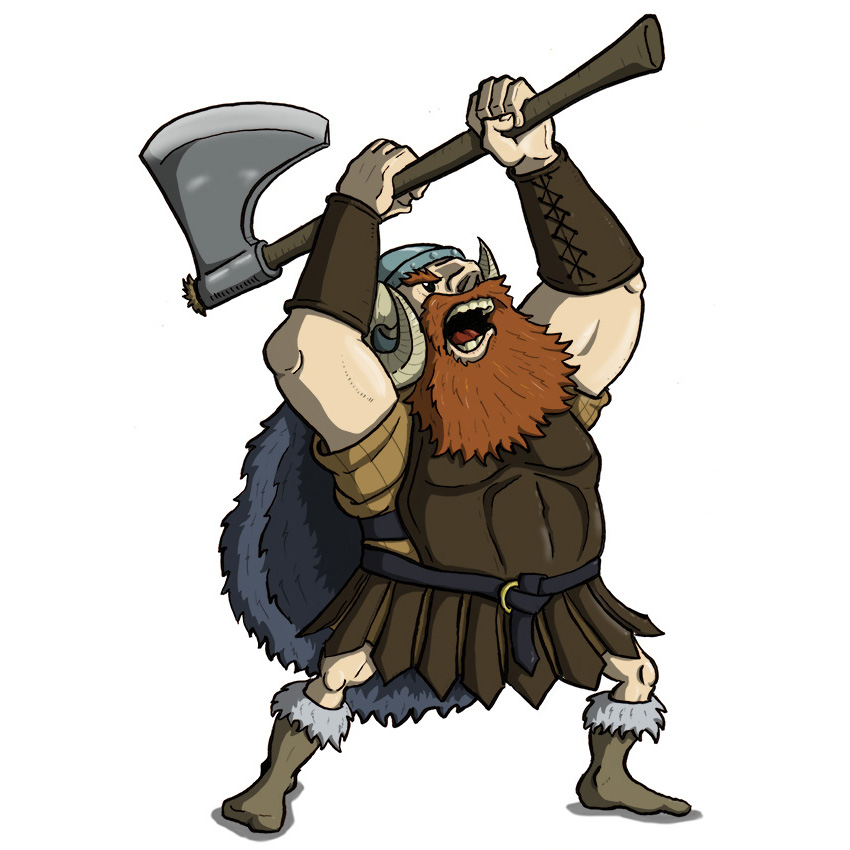
D&D Basic - NPC Gallery: Dwarf Berserker


D&D Basic - NPC Gallery: Dwarf Priest


Inktober Monstrosities: Z for Zorbo

zorbo - a strange koala-like creature that can absorb protective properties from its surroundings, as well as draining protective magical items.
The zorbo first appeared in the Monster Manual II for first edition AD&D, then later in the Monstrous Compendium Annual volume two...
... and that was it I thought, only to find out that it actually appeared in the Tomb of Annihilation adventure for fifth edition, which strictly speaking means it's disqualified for this list (the locathah appeared in Secrets of Saltmarsh AFTER it appeared here), so maybe it'll be replaced later... we'll have to see.


Inktober Monstrosities: Y for Yugoloth, Guardian

A bit of a cheat this one, since these monstrosities were originally called Guardian Daemons when they first appeared in the Fiend Folio for first edition AD&D and the Monstrous compendium volume two, for second edition. Only when reappearing in the second edition Monstrous Manual., were they defined as yugoloth, but with so few good monsters on y I'll grasp at any straw.


 |
| The DC for the save against the breath weapon should of course be 15, NOT 115(!). |
Inktober Monstrosities: X for Xill

In D&D the xill first appeared in the Fiend Folio for first edition AD&D and then in the Monstrous compendium, Fiend Folio appendix, for second edition. In third edition they got prime billing, appearing in the original Monster Manual.


